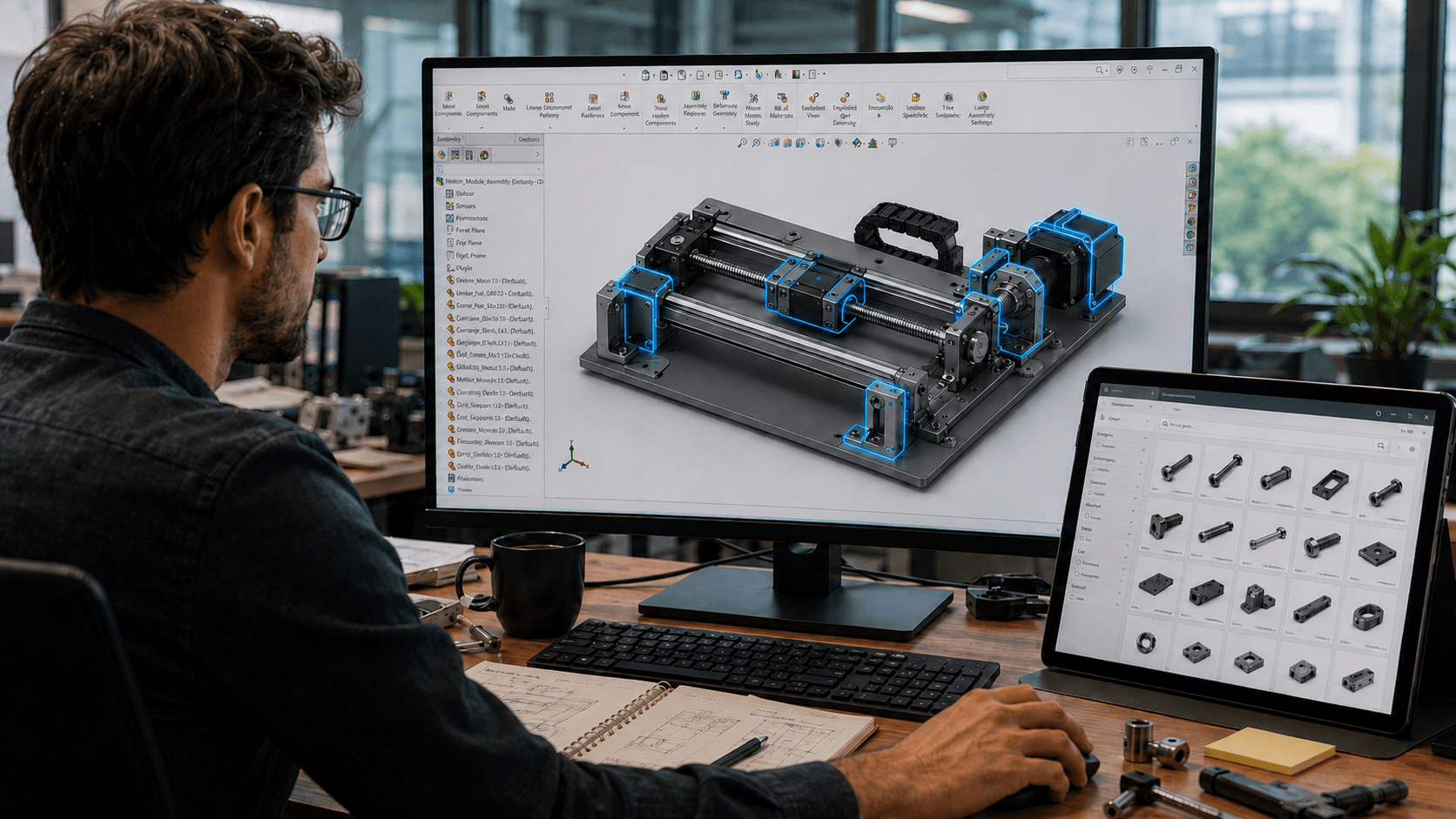
A huge chunk of assembly design isn’t original geometry. It’s fasteners, connectors, brackets, and off-the-shelf hardware that already exists, has already been manufactured a million times, and already has a downloadable CAD file waiting for you. Modeling these from scratch is one of the biggest time sinks for junior engineers, and it’s completely avoidable.
Beyond saving time, these resources do something else that matters just as much: they help you specify real, procurable parts. A part you found on a proper supplier site is something you can hand straight to procurement with a part number, instead of a generic model that someone in purchasing then has to reverse-engineer into an actual buyable component. Knowing where to look, and being able to say exactly which supplier and part number you used, is also something that quietly separates a design engineer who’s done real production work from one who’s only worked on personal projects.
Here’s the list, in the order I’d actually reach for them.
1. McMaster-Carr
If you do any mechanical design work at all, this is the site you’ll open the most. McMaster-Carr is a US-based industrial supplier with an enormous catalog of fasteners, fittings, hardware, tubing, and raw materials, and nearly every part on the site has a free downloadable CAD model in multiple formats. The catalog is also just genuinely well organized: parametric filtering, clear technical specs, and diagrams that explain terminology as you search, so it functions as a reference tool even when you’re not downloading anything.
If you’re designing outside the US, the direct equivalents are Accu (accu.co.uk) for the UK market and Bossard (bossard.com) for European and global industrial fastening, both offering similar catalog depth and downloadable CAD models for standard hardware.
Also worth having in this same tier is Misumi (us.misumi-ec.com), particularly strong for configurable mechanical components, linear motion parts, frame structures, and machine building hardware, with CAD models that let you set exact dimensions and specs before downloading, rather than choosing from a fixed catalog size.
2. GrabCAD
GrabCAD is a community-driven CAD library where engineers upload models of everything from mechanical assemblies to standard components. It’s less structured than a supplier catalog, but it’s an excellent second stop for two reasons: it often has models for parts that aren’t sold through a formal industrial supplier, and browsing it is genuinely useful for design reference. If you’re about to design something, there’s a good chance someone has already designed something close to it and shared it, which means you’re refining an existing idea instead of starting from a blank sketch.
3. TraceParts, Amphenol Socapex, and TE Connectivity
For anyone working in electromechanical design, rack-based systems, or cabinet and enclosure design, this trio is the most valuable set of resources on this list.
TraceParts is a large multi-manufacturer CAD library covering everything from connectors to structural components, useful as a broad search tool when you’re not sure which manufacturer makes the part you need.
Amphenol Socapex and TE Connectivity are connector manufacturers whose sites go far beyond just connectors. Both offer CAD models for a wide range of electrical and electromechanical components used heavily in rack-based systems and cabinet design, board-to-board connectors, backshells, cable assemblies, and enclosure hardware. If you’re doing any work involving cabinet layouts, wiring interfaces, or rack-mounted electronics, these two sites should be part of your default search before you consider modeling a connector or interface component yourself.
4. Digikey and Mouser
Digikey and Mouser are electronic component distributors, but they’re just as essential for mechanical and electromechanical design engineers as they are for electrical engineers. Beyond datasheets and specifications, both sites provide CAD models for connectors and electronic hardware, which matters the moment your enclosure or rack design needs to account for real component footprints and mounting geometry instead of placeholder shapes.
5. nVent
For anyone specifically working in rack-based systems and cabinet design, nVent is, in my experience, the best single resource on this list for that category. Their catalog covers thermal management, enclosures, rack accessories, and cabinet hardware, and the CAD models are detailed enough to design around directly rather than needing significant rework once you bring them into your assembly.
Why this matters beyond saving time
Using these resources isn’t just about speed, though that’s the immediate benefit. It changes how your designs move through the rest of the process. A model pulled from a real supplier catalog comes with a real part number, real specifications, and real lead times, which means procurement can act on it immediately instead of chasing you for clarification. It also means your BOM reflects reality from day one, rather than a set of placeholder parts that someone has to reconcile with actual purchasable hardware later.
Knowing these sites, and knowing which one to reach for depending on the part category, is a small habit that compounds fast. The engineers who move quickly through assembly design aren’t the ones who model faster. They’re the ones who know when not to model at all.