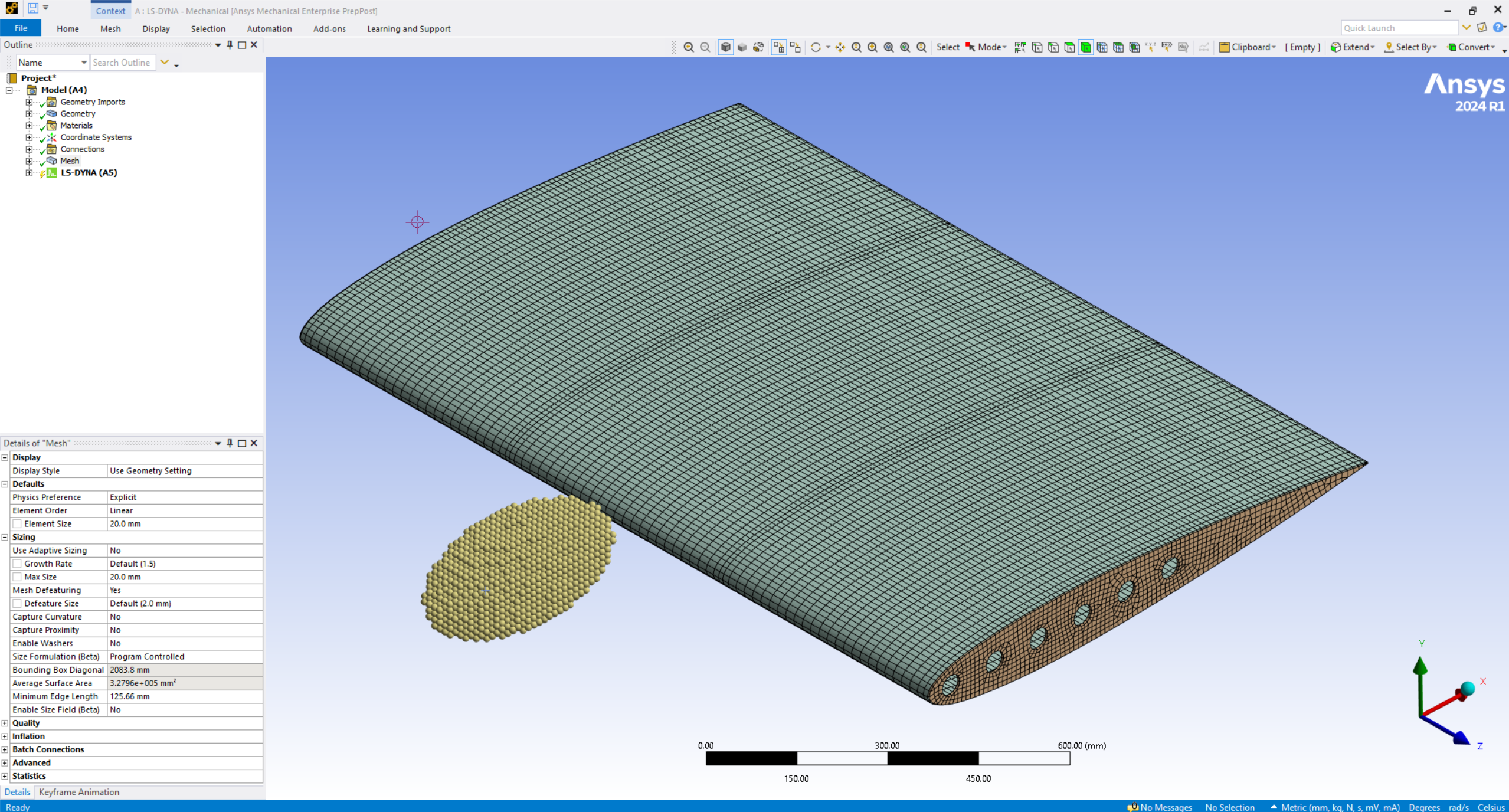
Production-level SPH bird strike simulation on an airfoil in Ansys LS-Dyna - the same explicit dynamics methodology used for aerospace impact and crashworthiness certification.

Bird strike certification is one of the most critical structural validation requirements in aerospace engineering, governed by FAA/EASA airworthiness standards. This project teaches you a production-level SPH (Smoothed Particle Hydrodynamics) simulation workflow by walking through a complete bird strike event on an airfoil geometry, the same methodology used in industrial impact and crashworthiness analyses. By completing this project, you will understand how SPH particles replace the traditional Lagrangian mesh for fluid-like impactor behavior, eliminating the mesh distortion problems that plague explicit FEA solvers in high-velocity impact scenarios. The skills you build here transfer directly to adjacent simulations including bird strike on engine fan blades, hailstone impact on composite panels, water ditching, soft-body projectile impact on fuselage skins, and tire burst analyses. You will also learn best practices for hourglass energy control, one of the most commonly misunderstood parameters in explicit dynamics, and a practical technique for reducing computation time without sacrificing result accuracy, which is essential when running parametric studies or working with limited HPC resources.
Primary workflow requires Ansys Workbench LS-Dyna 2021 or newer. Universal geometry formats (STEP, IGES, Parasolid, SpaceClaim) also open in older LS-Dyna releases.
Production-level SPH bird strike simulation on an airfoil in Ansys LS-Dyna - the same explicit dynamics methodology used for aerospace impact and crashworthiness certification.

Bird strike certification is one of the most critical structural validation requirements in aerospace engineering, governed by FAA/EASA airworthiness standards. This project teaches you a production-level SPH (Smoothed Particle Hydrodynamics) simulation workflow by walking through a complete bird strike event on an airfoil geometry, the same methodology used in industrial impact and crashworthiness analyses. By completing this project, you will understand how SPH particles replace the traditional Lagrangian mesh for fluid-like impactor behavior, eliminating the mesh distortion problems that plague explicit FEA solvers in high-velocity impact scenarios. The skills you build here transfer directly to adjacent simulations including bird strike on engine fan blades, hailstone impact on composite panels, water ditching, soft-body projectile impact on fuselage skins, and tire burst analyses. You will also learn best practices for hourglass energy control, one of the most commonly misunderstood parameters in explicit dynamics, and a practical technique for reducing computation time without sacrificing result accuracy, which is essential when running parametric studies or working with limited HPC resources.
Primary workflow requires Ansys Workbench LS-Dyna 2021 or newer. Universal geometry formats (STEP, IGES, Parasolid, SpaceClaim) also open in older LS-Dyna releases.